Pacific Daily News: https://www.guampdn.com/election/2026/limtiaco-torres-share-visions-for-guam-voice-in-congress-at-womens-chamber-of-commerce-forum/article_6476d93c-7b7a-4b22-a47e-3cd9066af51b.html
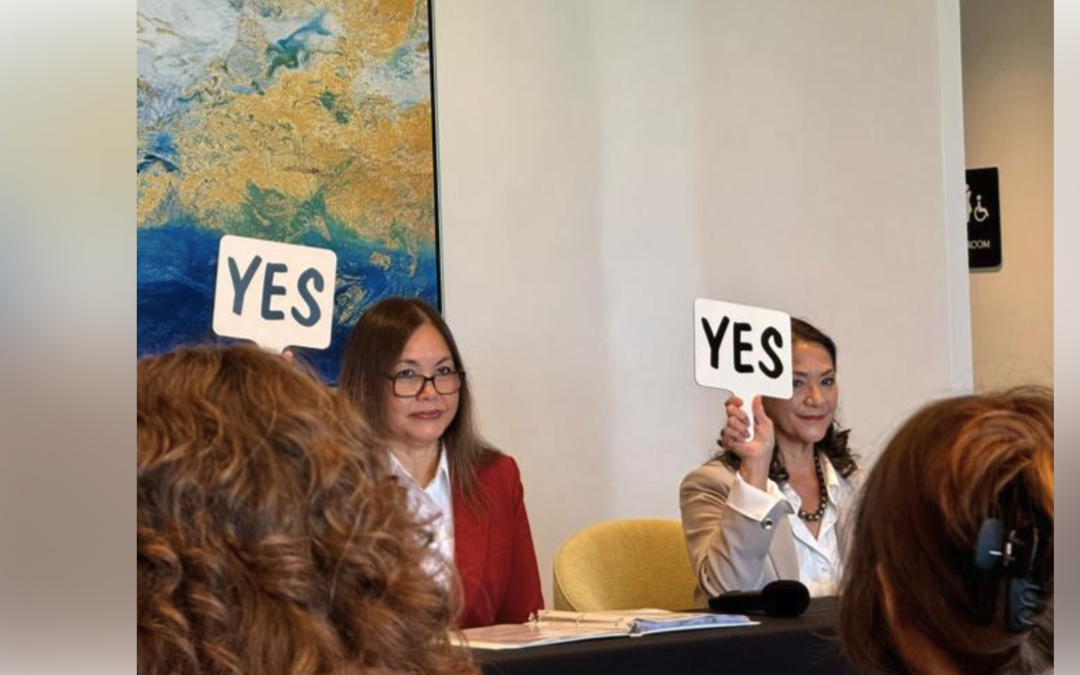
Delegate candidates former U.S. Attorney Alicia Limtiaco and former Sen. Mary Torres offered sharply different approaches to federal advocacy, outlining how they would handle abortion policy, deep-sea mining, shipping costs, small business protections and preservation of CHamoru language and culture, at a forum hosted by the Guam Women’s Chamber of Commerce on Thursday.
It was among the first candidate forums ahead of the Aug. 1 primaries.
Torres is challenging incumbent Del. James Moylan in the Republican race, while Limtiaco, a former Guam attorney general, is running unopposed on the Democrat side.
Limtiaco and Torres largely aligned on core policy goals, including access to reproductive health care, opposition to deep-sea mining and lowering Guam’s cost of living.
They diverged on how to achieve those outcomes, each pointing to different uses of federal committees, coalitions and data-driven policy tools as Guam’s nonvoting delegate to the U.S. House of Representatives.
The most direct policy divide came during discussion of federal abortion legislation.
“Let me begin by stating that personally I am pro-life; however, I believe that reproductive care is a decision between a woman and her doctor,” Torres said at the forum held at Crowne Plaza Resort Guam in Tumon.
Torres connected her legislative record to what she described as support systems for families and children.
“As a senator, I took this to heart and I passed legislation, such as the Newborn Infant Safe Haven Act (Public Law 34-120). I addressed homelessness, expanded foster care for children and I protected protections for victims of sexual assault and stalking,” she said.
Torres said she would review any federal proposal through legal and constitutional standards while ensuring access to care and protections for families.
Limtiaco said abortion policy on Guam is shaped directly by federal authority over U.S. territories.
She said Guam must remain directly involved in federal decision-making on the issue.
“If a federal abortion measure came towards me as Guam’s delegate, there would be three responsibilities that would guide me: respect for the rule of law, respect for the will of the people and ensuring that Guam’s voice is heard, that we are at the table at any decision-making and thought provoking process,” Limtiaco said.
She described abortion as a complex and deeply personal issue and pointed to prevention and maternal health concerns, including teen pregnancy rates.
“We also must be very focused on prevention, including preventing or reducing teenage pregnancy,” Limtiaco said. “Guam’s historical teenage pregnancy rate is two to three times higher than the average in the United States, and we should be very concerned about that.”
During audience questioning, former Bureau of Women’s Affairs Director Jayne Flores asked both whether they would support legislation protecting reproductive autonomy, including access to abortion care and contraception regardless of congressional control.
Limtiaco said she would follow community direction in shaping her advocacy.
“There are going to be three responsibilities that will guide me if any federal abortion measure comes forward,” she said. “Whatever it may be, will be the direction and the advocacy that I am going to put forward, and in that circumstance, for example, Jayne, as you put forward, that is what I would fight for.”
Bill 291-36, also known as the Guam Heartbeat Act, was modeled after Texas law and sought to ban most abortions once fetal cardiac activity is detected and allow private lawsuits against providers.
“I was one of the senators who opposed it, and I opposed it for the fundamental reason that I believe that a body of lawmakers should not dictate a woman’s reproductive right and decisions that are privately made between herself, her husband, her physician,” she said. “I would never advocate for taking a position that takes the right of reproductive care away from a woman, in whatever shape or form that is.”
Deep-sea mining
Federal plans to open nearly 70 million acres for deep-sea mining near Guam have raised concern among residents and officials about environmental damage and local consent.
Limtiaco and Torres said they oppose deep-sea mining but differ in approach.
Torres tied opposition to cultural identity and ocean dependence across the Pacific, and criticized the island’s current representation in Congress over past testimony on the issue. She pointed to more than 65,000 people in Guam and across the Pacific who registered opposition to deep-sea mining proposals.
“Since then, the Bureau of Ocean Energy Management doubled the footprint of deep sea mining in this area,” she said. “This is exactly why Guam needs a clearer and stronger voice in Washington.”
Limtiaco pointed to her work with national, regional and international organizations, including the United Nations, in opposing deep-sea mining.
“In fact, just over the last couple of days, the National Asian Pacific American Bar Association, or NAPABA, approved a resolution that would demand that the federal government comply with all domestic and international laws requiring [Washington] D.C. in light of the events that are happening here in the Pacific,” she said.
Limtiaco described her role in requesting the resolution as the only Pacific Islander on the board.
She also referenced international agreements tied to Indigenous rights, including the UN Declaration on the Rights of Indigenous Peoples and the high seas treaty, saying any activity must include consultation and consent from affected communities under domestic and international law.
Shipping costs
On Guam’s cost of living and federal policy barriers, Torres said federal spending tied to military buildup has not translated into lower costs for residents.
“It should concern all of us that billions of dollars are pouring into Guam with military buildup and defense spending and yet people are working harder and harder at not feeling that we’re really getting ahead,” she said.
She identified shipping costs and federal regulatory barriers as her top priority, saying she would seek review of policies she said drive up prices, using the National Defense Authorization Act, NDAA, and military expansion as leverage.
Torres said she sent a letter to the Federal Trade Commission requesting a study on fuel pricing on Guam. She said assumptions about repealing the Jones Act may not capture the full economic impact on the island.
She also called for broader reform of federal shipping restrictions and modernization options supported by bipartisan effort.
Limtiaco said she would prioritize strengthening small business access to capital, federal contracts, workforce programs, infrastructure investment and energy resilience funding.
She said she would defend programs such as SBA 8(a), HUBZone, Small Business Development Centers and 504 loan programs.
The SBA 8(a) program supports socially and economically disadvantaged businesses by helping them compete for federal contracts, while HUBZone provides contracting advantages to businesses located in historically underused areas to promote local economic development.
SBDCs offer counseling, training and technical assistance to small business owners and entrepreneurs. The 504 loan program provides long-term, fixed rate financing for major fixed assets such as real estate and equipment to support business expansion and job creation.
The proposals would eliminate set-aside sole-source contracts, remove the 5% federal contracting goal for women-owned firms, end race- and sex-based eligibility standards in SBA 8(a), eliminate reporting requirements for small disadvantaged businesses and repeal the Minority Business Development Act of 2021.
Education, child care
Torres called education essential for long-term economic stability and said many school facilities require modernization. She called for stronger recruitment and retention of teachers and expanded partnerships with local institutions.
Limtiaco described her own public school background and said she would focus on protecting federal education funding, rebuilding schools and improving outcomes. She cited Title I, IDEA, Head Start, nutrition programs and career technical education as priorities.
On child care, Torres linked workforce participation to caregiving demands, citing Bureau of Labor Statistics data identifying child care as a leading reason women leave the workforce.
She referenced her personal experience balancing early motherhood and education.
It took her nearly eight years to get back to college, she said.
Torres said she would support expanded federal child care subsidies, funding models that reflect Guam costs, facility expansion grants and employer-based child care incentives.
Limtiaco said child care is tied to both economic stability and workforce capacity and said military buildup has increased demand for services.
She said she would expand existing federal programs including Head Start, Early Head Start, early intervention services and workforce-related child care assistance, and examine additional support for providers.
During audience questioning, Guam Visitors Bureau General Manager Regine Biscoe Lee asked both candidates to state their positions on the Guam-CNMI visa waiver and whether expanding it could support key industries on Guam, including tourism.
Both tied visa policy to Guam’s ability to fill critical jobs and support economic growth, particularly in tourism and other labor-dependent sectors.
Limtiaco said expansion of the Guam-CNMI visa waiver “would be one of the priority federal policy decisions” she would focus on.
She said attention should extend beyond H-2B visas to include H-1, professional visas and J-1 visas, arguing those programs directly affect Guam’s ability to recruit specialized workers. She said these visa categories are critical for hiring doctors, nurses, educators and other skilled professionals needed to fill gaps in health care and other specialized services on the island.
Both candidates closed cultural discussion by tying CHamoru language preservation to lived experience.
Torres opened in CHamoru and cited population concerns, saying preservation requires federal support for Indigenous language programs, artisans and cultural practitioners.
Guam’s small population requires its perspective to be represented in national policy discussions, she said.
Limtiaco recalled her mother’s experience being punished for speaking CHamoru in school after World War II, which she said shaped her view of language loss.
She called for sustained investment in language revitalization, teacher training, curriculum development and immersion programs, and said cultural preservation requires long-term commitment.
Torres said leadership depends on action rather than title and accountability to voters.
Limtiaco said leadership requires direct engagement with residents and consistent communication through public reporting, town halls and digital platforms.
Amanda Alag, co-chair of GWCC’s Government Committee, led the Q&A format for the first in the organization’s “Members in Action” series.
She said the series aims to keep members engaged in civic life and policy discussions that affect Guam’s economy and workforce.